
KANBrief 4/25
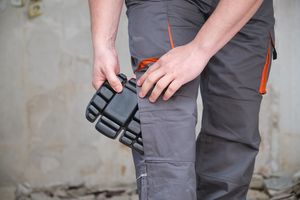
Work performed in a kneeling position places considerable stress on the knee joints. The risks of harm to health are particularly high in the construction sector and the skilled trades. The EN 14404 standard, which was revised at the end of 2024, now covers a wider range of forms of knee protector and contains clear provisions for ensuring effective protection.
Screed layers, tilers, interior decorators and workers in other manual trades spend up to 70% of their working time in a kneeling position. This places considerable stress on the knee joints, menisci, joint capsules, ligaments and bursae. This in turn often leads to conditions such as meniscal injury and chronic bursitis, which are formally recognised in Germany as occupational diseases. Knee injuries such as abrasions and puncture wounds or skin diseases can also be very painful and lead to prolonged absences from work.
Organisational measures and technical aids are intended to obviate the need for work to be performed in a kneeling position. Where this cannot be avoided, suitable knee protectors must be worn to reduce the stress on the knee.
Knee protectors are standardised in EN 14404, Personal protective equipment – Knee protectors for work in the kneeling position. In the standard’s latest revision, the experts on the European standards committee chose to divide it into six parts which describe the various test methods and four types of knee protector for different areas of application:
Type 1, 2 and 4 knee protectors constitute personal protective equipment within the meaning of EU Regulation 2016/425. Knee protectors that have passed the mandatory type examination by a testing and certification body and thus meet the requirements of EN 14404 Parts 2 to 4 and Part 6 must be marked with the CE mark, the number of this standard and the performance level for puncture resistance.
Part 1 of EN 14404:2024 describes test methods for knee protectors. The requirements for the various knee protector types are set out in Parts 2 to 6. These include, for example, the innocuousness of the material, the force distribution and the shock damping properties. Another important aspect is the puncture resistance, for which the standard distinguishes four performance levels. The new level 1U supplements the existing Categories 0 to 2 and, like level 2, also guarantees protection on uneven surfaces.
Furthermore, requirements are set out for restraint of the knee protectors and for ergonomics and comfort. The knee protector must remain in the intended position when the wearer kneels and bends the knee. At the same time, the straps used for restraint must not compromise venous drainage in the leg. The standard also specifies how knee protectors are to be labelled and what information on safe and effective use is to be provided by the manufacturer.
Parallel to the standard, DGUV Rule 112-191 (use of foot and knee protection) has also been revised. The new version (to be published shortly) refers to the new series of standards and contains a wealth of practical guidance and explanations for users of knee protectors.
Nicola von der Bank
Nicola.Bankvonder@dguv.de
Olaf Mewes
olaf.mewes@dguv.de