
KANBrief 4/25
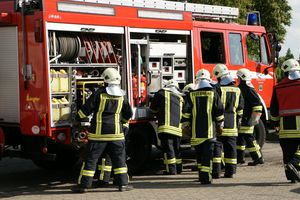
Firefighting and fire protection are the subject of numerous standards, addressing topics from respiratory protection for firefighters to smart protective equipment, fire extinguishers and fire blankets for electric vehicles. Tim Pelzl, Head of the Expert committee Fire and emergency services, fire prevention and protection of the German Social Accident Insurance (DGUV), talks about why standards are particularly important for occupational safety and health in the fire services.
One major topic is fires involving high-voltage batteries, notably in vehicles, but also in domestic applications and laptops. Special fire extinguishers are needed for fighting fires on these lithium-ion batteries. Standards are currently being developed that will enable the effectiveness of different fire extinguishers to be compared objectively, e.g. in the procurement process. The same applies to fire limitation (or fire containment) blankets: when the high-voltage battery of an electric vehicle is damaged, it presents a risk of fire. A fire limitation blanket – a large piece of fabric that can be placed preventively over an entire electric vehicle – prevents fires from spreading to the surrounding area should they break out.
It goes without saying that personal protective equipment is always an important topic for the fire services. A lot of standardisation activity takes place in this field at international level. Not all topics are immediately apparent. An example is command management systems for major cross-border deployments. Another is drinking water protection, specifically the design of vehicles and valves to prevent contaminated water from flowing back into the fresh water supply system. These are just examples of what’s currently happening in standardisation work at national, European and international level.
You’re right to mention smart PPE: it’s an important topic. Sensor and other technology for supporting firefighters during deployments against fires is integrated into their helmets, boots and jackets. It includes LED warning lights that switch on and off automatically; sensors that monitor body functions, or the ambient conditions, for example by detecting toxic gases; through to augmented reality, where information possibly needed by emergency responders, such as thermal images or information for orientation in buildings, is displayed to them in respiratory masks or goggles.
A lot of research is already being undertaken in this area, but I’m not yet aware of any solutions that have reached market maturity. Some of the technical challenges are considerable. It’s also not always clear what legal requirements – beyond the PPE Regulation – apply to a combination of PPE and electronics, and what implications this has for the conformity assessment procedures. Data privacy is also a major issue whenever people’s biometric data is collected; some people may choose not to use certain items of PPE because they don’t trust the technology and how it handles their data.
We also have to recognise that, as yet, standardisation in this area is insufficient; one example is how data formats are supplied to interfaces. But there are also very tangible aspects. For example, the requirements for firefighters’ clothing to withstand exposure to flames and high temperatures are quite strict. Electronics integrated into smart PPE must be tested along with it, and must meet the same requirements. This must also be reflected in the relevant standard.
A lot of subject-matter in our sector has been addressed by standardisation – in some cases perhaps in more detail than necessary. At the same time, a steady stream of new technology is coming onto the market that we’d like to have standards for, as the result is otherwise chaos. One example are trolleys for firefighters’ equipment, which can be loaded onto vehicles and unloaded at the deployment site very quickly. These have now become standard. But many of the products on the market aren’t properly thought through: some of the trolleys are too high or too heavy and can tip over; they may have pinch points; and they need to be secured properly on the vehicles. This brings us to the point where standardisation is needed, so that a common understanding is reached and all components are compatible with each other.
There are also times when we wish that standardisation allowed a little more flexibility. One example is the interoperability of respiratory protective devices, i.e. the question whether an item of equipment from manufacturer A can be combined with parts from manufacturer B. This isn’t possible at present, as certification requires all components to be from the same manufacturer. We’re therefore trying to raise this issue within standardisation in order to establish uniform interfaces that allow parts from different manufacturers to be combined where this would be an advantage.
More and more often, we’re having to deal with extreme weather events such as torrential rain, storms and high temperatures. In recent years, we’ve seen forest fires in Germany on a scale and of a duration that we wouldn’t previously have considered possible. Obviously, this is also reflected in the equipment that we’ll need in the future. For wildfires, for example, thinner hoses that are easier to carry are needed, and smaller pumps weighing perhaps only 50 rather than 200 to 300 kilogrammes that can be carried by two people several hundred metres over difficult terrain, perhaps even uphill, for flexible deployments.
At the same time, much larger and heavier equipment is also often required than what we’ve been used to, and PPE must also be adapted. When fighting wildfires, firefighters need completely different PPE to the clothing that’s called for when they enter burning buildings. The latter is highly insulating and would be physiologically unbearable during a major wildfire, at temperatures of 30 °C and for several hours. Standardisation is particularly important for such scenarios.
In Germany, responsibility for fire protection lies with the local authorities. Subsidies for vehicles or the procurement of PPE granted by Germany’s administrations at state level are often conditional upon the equipment or vehicles complying with the relevant standards. Firefighters are often volunteers and don’t have the time to deal with technical details. When they note that an item of equipment complies with the standard specified by the responsible accident insurance institution, they can be confident that the technical occupational safety and health requirements are met. This makes standards a crucial factor in occupational safety and health. That’s why it’s also important for the German Social Accident Insurance and KAN to be involved in standards development work, so that occupational safety and health aspects are considered from the outset.