
KANBrief 4/25
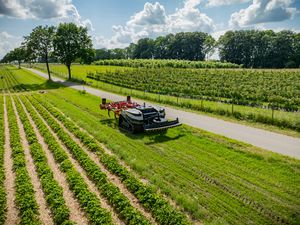
Highly automated, driverless mobile machines are increasingly being used in agriculture. In a KAN position statement, occupational safety and health representatives call for the safe design of these machines to be addressed, in order for the risks to workers and third parties to be reduced.
Robotics is finding its way into agriculture – in the form of highly automated, driverless mobile machinery. Examples are multi-purpose towing machines serving as a replacement for conventional tractors, or specialised robots for hoeing the soil, weeding, or spraying pesticides selectively onto individual plants. This not only increases efficiency and offsets the growing shortage of skilled workers: OSH representatives also view this new equipment as having the potential to enhance occupational safety and health. For example, the resulting changes to the task profiles of agricultural machinery operators can be expected in turn to reduce hazards presented by dust, heat, hazardous substances (pesticides) and vibration, and also stress responses to mental workload. The biggest current cause of accidents on agricultural machinery could also be mitigated appreciably: where machinery is operated manually, climbing onto it and off it accounts for at least 50% of all accidents. At the same time, the use of robots gives rise to new hazards, which must also be addressed. Beginning at the design stage, it must be ensured that risks associated with the machines and their use are eliminated, or where this is not possible, at least reduced to a minimum.
In Germany, occupational safety and health relating to driverless mobile agricultural machinery falls within the remit in the first instance of the SVLFG (the German Social Insurance for agriculture, forestry and landscaping). The SVLFG has been fielding enquiries on this topic from both farmers and manufacturers for some time now. It’s pleasing to see manufacturers themselves proactively asking OSH experts how safety can be ensured where robots are used. Driverless systems in agriculture are also being addressed by standards developers. Initial standardisation documents have been developed at the international level, for example addressing partially automated, semi-autonomous and autonomous agricultural machinery and tractors (Agricultural machinery and tractors – Safety of partially automated, semi-autonomous and autonomous machinery). Occupational safety and health representatives consider these documents still to be unsatisfactory, however. The SVLFG’s experts are involved in standardisation work; however, they do not wish to participate in standardisation activity or respond to enquiries alone, but rather to base their activity on a common position agreed between all stakeholders in occupational safety and health.
With its expert discussions, KAN offers a proven means of creating a consensus between the German stakeholders in occupational safety and health. In February 2025, representatives of all stakeholders in KAN met, supported by experts from the German Federal Ministry of Agriculture, the Ministry of Agriculture of the State of North Rhine-Westphalia and the Chair of Autonomous, Collaborative Agricultural and Sensor Systems at Osnabrück University of Applied Sciences. The objective was to develop guiding principles for the safety of highly automated, driverless mobile agricultural machinery in field use, and thereby to reduce the risks presented by these machines for workers and third parties.
The expert discussion deliberately avoided formulating technical details; instead, guiding principles were laid down for the aspects considered essential by the OSH representatives. The technical form by which this is to be implemented is to be clarified, for example, in discussions with manufacturers, or in standards committees. This strategy has the advantage that the technical details reflect up-to-date good practice at a given point.
Automatic detection of persons in the vicinity of agricultural robots is at the heart of the demands made by occupational safety and health representatives. The safety-related functions of the sensor systems used for this purpose must be consistent with up-to-date good practice. This applies both to individual agricultural machines and combinations of towing machines and implements. It is emphasised that technical measures have precedence over organisational measures.
The danger zones of highly automated, driverless mobile agricultural machinery must be defined comprehensively. At the same time, it must be considered that these danger zones are generally accessible to the public. Furthermore, dynamic factors must be taken into account in the hazard scenario, for example when a further mobile machine moves into the area occupied by a driverless machine.
Human beings must be detected sufficiently reliably and in consideration of all hazards. This detection applies to workers, but must also cover third parties, particularly children, persons with impaired ability, etc. Safety-related sensor functions and applications must adhere to up-to-date good practice. Detection of human beings forms a part of the protective measures required for compliance with European machine safety legislation. The safety level attained by current assistance systems is not sufficient for this purpose.
These general criteria apply to both the standalone machine and the combination of tractor and implement. The term “implement” covers all trailed, semi-mounted or mounted equipment. Since technical measures take precedence over organisational measures, the implement must be detected sufficiently reliably by the tractor’s safety system. If necessary, the implement must be equipped with additional systems that are then integrated into the tractor’s safety system. For example, the tractor’s safety system can be responsible for monitoring the implement; should it determine that the combination is unsafe, it should prevent the tractor from moving off.
In order to test person recognition, the test specimens must be suitable for simulating standing, lying and kneeling adults and children wearing everyday clothing.
KAN adopted this position in July 2025. It now provides a working basis for occupational safety experts in standardisation committees and in discussions with manufacturers and users.