
KANBrief 4/25
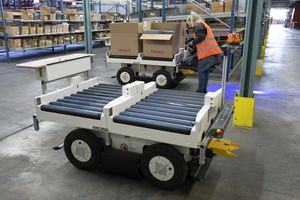
Great strides have been made in recent years in the development of digital technologies, including artificial intelligence. One result has been the creation of new applications for driverless mobile machines that can optimise work processes, reduce physical workloads and relieve workers of monotonous tasks. However, new risks and hazard scenarios are also foreseeable, and still pose challenges for safety technology.
Mobile robots, driverless transport equipment in industry and logistics, highly automated machines in agriculture: advanced automation technology is found in countless driverless mobile machines – and also in drones, and in four-legged and humanoid robots. However, machines are appearing on the market that are labelled as compliant without yet having been developed to full maturity, and their safety consequently not yet being guaranteed in all respects by technical means.
Given the growing success of driverless cars, mowing robots and vacuum cleaner robots for domestic use, it might reasonably be assumed that driverless (autonomous) machines can also be used without restrictions and in complete safety in factories and warehouses, on construction sites or in fields. What, though, do we understand by “autonomy”? In the automotive sector, different levels of autonomy have been clearly defined. However, this definition cannot readily be transferred to machines, as they are subject to different statutory provisions and therefore also different design requirements. Machines must comply with the essential health and safety requirements of the Machinery Directive 2006/42/EC and, in the near future, the EU Machinery Regulation 2023/1230. The legislator has introduced new requirements in the latter governing the autonomy of mobile machines and the use of self-evolving machine learning.
Legislation requires machinery to be safe for use for its intended purpose. As the new technology finds uses in more and more applications, interactions between workers and these machines are also increasing significantly. Use of the machines leads to new work situations, thereby also changing the workers’ activities. It is therefore important that these organisational changes, and the new interactions and the hazards associated with them, be taken into account.
The greatest physical risk is posed by direct collisions with persons present in the vicinity of a machine. A risk also exists of a person becoming trapped between a machine and a fixed object in proximity to it. The machine itself, a load or an obstacle with which the machine collides could also fall or tip over and hit a person.
The French national institute for research and safety (INRS) addresses these hazards by actively participating in the development of standards for these machines, in particular EN ISO 3691-4 for driverless industrial trucks. It also investigates how these machines can be integrated into predefined environments, with consideration for up-to-date good practice for the detection of persons. Since the machines are mobile and can therefore in principle move freely, they must be capable of being aware of their environment and moving safely within it.
Where mobile machinery is operated by drivers, the risk of collisions between machinery and human beings has long been known, yet still cannot be eliminated entirely by technical measures. The responsibility for using the machine safely therefore lies with the driver. Since autonomous mobile machines do not have drivers, the risk of collision and the other risks mentioned above must be prevented by means other than human intervention, ideally by technical solutions. Technical solutions still have their limitations, however. Although some mobile machinery features equipment such as safety scanners, this cannot cover all conceivable scenarios that may arise when the machine is moving in its environment. Until a technical solution is found that makes autonomous machines completely safe, it must be determined whether compliance with the Machinery Regulation can be guaranteed at all. Should this be possible, it will then be essential for operators to make thorough preparations for the use of these machines before purchasing them, i.e. to identify all hazards, stresses and risks and to take all necessary preventive measures.
It is also important that the tasks of mobile machinery be defined precisely and the flows of goods and people in the area where it is to operate be analysed. This enables organisational changes and potential interactions to be identified. A further important point is for the environment to be considered and its numerous variables determined: ground surface conditions, the potential presence of objects, humidity, temperature and light conditions, etc.
Since it is virtually impossible at present for technical protective measures to cover all relevant parameters, organisational measures must be taken in addition to cover residual risks. These include, for example, the design of the working environment, e.g. keeping the working area largely clear and providing information signage, and adequate information and training.
At present, deficits in technical safety equipment mean that the safety of driverless mobile machines still depends heavily on organisational measures. The task now is to eliminate these deficits as quickly as possible in order to integrate safety better into the design of machinery and thus improve safety for the breadth of applications in companies.
Jean-Christophe Blaise
Institut national de recherche
et de sécurité (INRS)
Head of the safety of work equipment and automated
systems laboratory
jean-christophe.blaise@inrs.fr