


Standardisation has long ceased to be a purely national matter; instead, it has been shifting increasingly to the European and international levels. European standardisation policy is a key instrument for shaping and strengthening the European single market. The establishment of uniform technical rules and standards for products and services in Europe enables them to be traded and used across borders.
Key legal acts and documents relating to European standardisation policy:
- The Standardisation Regulation (EU) No 1025/2012 has provided the legal framework for the development of harmonised standards in the European Union since 2012. It governs cooperation between the European Commission and the European standards organisations and sets out framework conditions such as the funding of European standardisation work mandated by the Commission and the involvement of stakeholders.
- The Vademecum on European Standardisation compiles key documents from the European Commission on European standardisation policy and related practice. It provides guidance without having legal status.
- Established in 2008, the New Legislative Framework (NLF) aims to improve the European Single Market for products. It builds on and modernises the so-called New Approach adopted in 1985. With the New Approach policy on technical harmonisation and standardisation, it was set out for the first time that European directives and regulations would define only the essential requirements, which would then be specified in detail by harmonised standards. The New Legislative Framework thus forms the basis for the uniform and safe placing on the market of products in the EU.
- The Guide to the implementation of EU product legislation ("Blue Guide") is the main reference document explaining how to implement the legislation based on the New Approach, now covered by the New Legislative Framework. The Blue Guide includes requirements regarding CE marking, product safety standards and conformity assessment.
Katharina Schulte
schulte@kan.de
European representation
KAN's European representation in Brussels advocates for KAN's interests directly at European level.
Presumption of conformity
Harmonised standards are of particular importance in Europe. These are standards drawn up by the European standards organisations CEN and CENELEC in response to a standardisation request by the European Commission to support European directives or regulations. Once the title and number of a standard have been published in the Official Journal of the EU, the standard is deemed to be harmonised and thereby gives rise to the presumption of conformity. This means that, by applying the standard, a manufacturer is automatically presumed to have met the mandatory legal requirements covered by that standard. This presumption of conformity offers manufacturers the major advantage of a reversal of the burden of proof.
However, users of standards should not rely solely on the normative content, but should also always check all available information regarding the completeness of standards. Even the publication of a standard’s reference in the Official Journal does not in itself guarantee that the standard covers all relevant legal requirements. To be on the safe side, users of standards should also carry out a risk assessment, in particular where required by the legal provisions for the product in question.
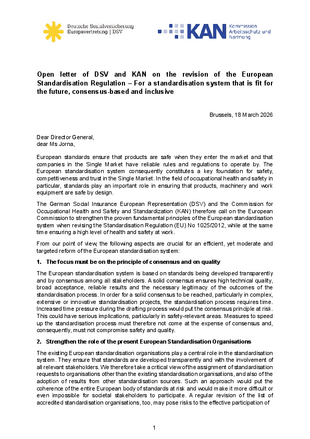

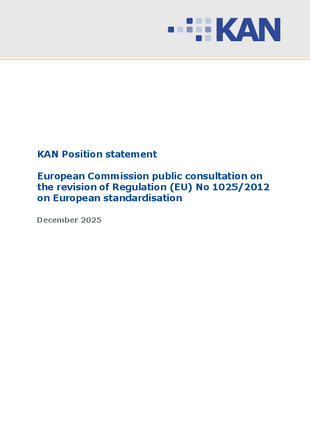
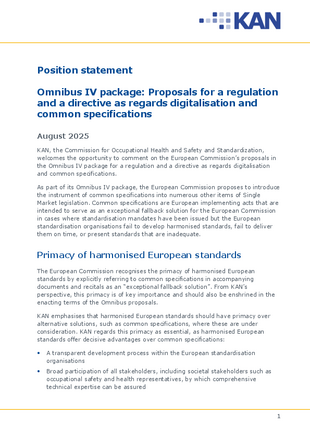
KANBrief articles on the subject
- KANBrief 1/26: Standardisation in the context of European policy objectives
- KANBrief 4/25: Omnibus packages: fast track procedure for reforms
- KANBrief 2/25: Revision of the EU Standardisation Regulation
- KANBrief 3/24: KAN involved in consultation on the EU Standardisation Regulation
- KANBrief 2/24: KAN's European Representation
- KANBrief 2/24: Cooperation between the international and European standards organizations
- KANBrief 2/23: The implementing act: an instrument for harmonized implementation of EU legislation
- KANBrief 4/22: Use of delegated acts in European legislation
- KANBrief 2/22: The new EU Standardization Strategy: pointing the way forward for standardization in Europe
- KANBrief 3/21: EU legislative procedures and scope for exerting influence
Further information
- European Commission website “Safety and health at work”
- Public consultations and feedback in the Have your say portal
Committee on the Internal Market and Consumer Protection
- Legislative Observatory: European Parliament’s database for monitoring the EU decision-making process
- Access to European Union law (EUR-lex) and summaries of important EU legislation (by topic)
- Notification system informing stakeholders about policy actions related to European standards to ensure proper consultation and market relevance before the action is taken (including standardisation requests and formal objections)
- Information by the European Commission on European standards