

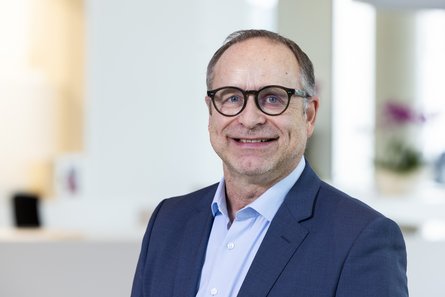
The chair of KAN rotates every two years between representatives of employers, employees and the state, respectively. In April this year, Kai Schweppe (representative for the employers’ side; Baden-Württemberg Industry and Employers’ Association, UBW) assumed the chair.
Four years have passed since the end of your last term of office, which ran from 2020 to 2022. What developments in the field of occupational safety and health and standardisation do you consider the most significant during the period since then?
The OSH and standardisation ecosystem has been in a state of flux over the past four years. My last term of office was marked primarily by technical topics. Since then, by contrast, occupational safety and health concerns in standardisation have become considerably more politicised. One of the key drivers of this change has been the “Malamud ruling” regarding free access to harmonized European standards, which has considerably increased the pressure on standards organisations. It has also led to an appreciable backlog in the listing of harmonised standards in the Official Journal of the EU. ISO and IEC standards adopted as European standards are particularly affected by this backlog. As a result of the intense pressure on the standardisation system to deliver results more quickly, the European framework is undergoing revision. Examples are the EU Standardisation Regulation and a streamlining of the standards organisations’ internal structures.
Concurrently with these developments, ongoing standardisation work in the field of artificial intelligence (AI) is a key focus. Underpinning the AI Regulation is currently one of the European Commission’s key priorities. Policymakers are calling for standardisation activity to be accelerated considerably in order to create legal certainty; this is, however, a complex and delicate undertaking. A faster pace of standardisation must not result in the opportunities for stakeholder participation being restricted.
Efforts, at times far-reaching, have been and are being made by Germany to reduce bureaucracy. In this context, what benefit can standards contribute to occupational safety and health, and what role does KAN play?
Standards significantly reduce the pressure on the legislative process – but only if they are used judiciously. A classic example of the effective avoidance of bureaucracy is the New Legislative Framework, which keeps legislation streamlined. Technical product properties are addressed by harmonised standards, enabling adjustments to be made more swiftly and with greater flexibility.
At the same time, we must be vigilant if we are to prevent standardisation from creating a further regulatory layer. A risk exists of bureaucratic creep, particularly if standards include complex or excessive certification requirements. Where the safety and health of workers at work is concerned, responsibility lies primarily with the social partners and other OSH stakeholders. These parties are well placed to find solutions that are much better tailored to the specific requirements in companies than those that could be reached by generic standardisation activity.
KAN assumes an important function in this context, as it relieves the occupational safety and health stakeholders of some of their workload by continuously monitoring work items in standardisation and subjecting them to expert evaluation. The objective is to ensure at an early stage that standards impacting upon occupational safety and health add genuine value and do not lead to unnecessary administrative hurdles.
Developments such as artificial intelligence and efforts to establish management system standards are just two examples of how KAN’s remit has expanded significantly over the years. In what areas do you currently see the greatest challenges with regard to occupational safety and health and standardisation?
Developments in the area of AI and in management system standards highlight a key trend: the increasingly interdisciplinary nature of occupational safety and health. We are witnessing more and more aspects of occupational safety and health appearing in standards that did not include such aspects in their scope in the past.
In the first instance, this is a positive sign: it shows that occupational safety and health is firmly anchored in the collective consciousness and is consistently given consideration when new developments emerge. The fact that occupational safety and health is now viewed as an integral part of a range of specialist fields rather than in isolation represents significant progress. However, this presents a significant challenge for an occupational safety and health regime that is to be fully functioning. We must prevent the emergence of a thicket of conflicting regulations that only leaves users baffled. A coherent and comprehensible system is crucial if parties responsible for the safety and health of workers at work are to be given the reliable guidance they need for practical implementation.
This is precisely the area addressed by KAN’s work. Our task is to coordinate the different strands of standardisation and to monitor them for consistency, in order to ensure the practicable and legally sound implementation of occupational safety and health across the board.