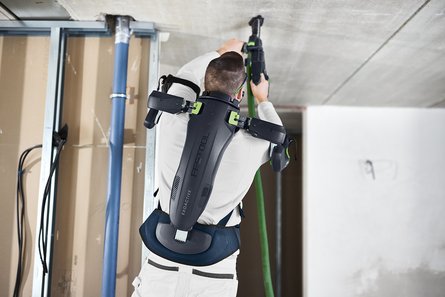
Exoskeletons have the potential to provide workers with relief and support during activities that are muscle-intensive or involve constrained postures. Standards organisations are currently conducting projects to formulate product requirements for exoskeletons. KAN has published a position paper on the standardisation of exoskeletons. This now serves as a basis by which the perspective of occupational safety and health stakeholders can be presented during development of the standards.
The DGUV defines exoskeletons as technical systems worn on the body and exerting a force upon it through mechanical coupling. Their purpose is to support the musculoskeletal system during physical work. These systems are increasingly used as work equipment in companies. In addition to providing relief during muscle-intensive work, exoskeletons provide support during activities involving forced postures, such as work performed above shoulder level. The occupational safety and health community aims to ensure that only products that are safe and not detrimental to health are used in the workplace. Furthermore, exoskeletons should be used to reduce physical stress, and not solely to increase productivity. Their use in the workplace must always follow the “TOP” hierarchy of measures, i.e. technical solutions must take precedence over organisational and personal measures.
Many of these objectives could be achieved through high-quality safety standards. To date, the standards organisations DIN, CEN and ISO have not yet published any product standards addressing exoskeletons. However, work on a DIN technical specification (DIN/TS 33442, Exoskeletons – General requirements and test methods) is nearing completion. This document is the first to set out requirements for design and instructions for use, and establishes a framework for testing exoskeletons’ technical and functional properties. Formulating such uniform descriptions presents a challenge, as the wide variety of exoskeleton designs and areas of their application makes uniform assessment difficult. It should also be noted that exoskeletons meet the definitions set out in European legislation relating to machinery, medical devices and personal protective equipment (PPE) and may therefore fall within any of the corresponding legal frameworks, depending on how the manufacturer defines their intended use. Together, these aspects prompted KAN to formulate a position agreed between the German stakeholders in occupational safety and health on the standardisation of exoskeletons, with a view to influencing the content of the relevant standards and ensuring that only exoskeletons that are safe and not detrimental to health are placed on the market.
Agreed occupational safety and health position on standardisation
In February 2026, representatives from all stakeholder groups represented within KAN met for an expert discussion to agree on the German occupational safety and health opinion on the standardisation of exoskeletons, and to set it out in the form of a KAN position paper. This also involved an exchange of views on the legal classification of exoskeletons within the European Single Market, as this may also have implications for standardisation.
The KAN position paper first lists aspects that must be taken into account by standards containing product requirements for exoskeletons. In addition to ergonomic requirements, it lists requirements relating to exoskeletons’ mechanical function and the methods for testing it. A key focus lies on the instructions for use which are deemed necessary. It is important that the capabilities and limitations of the exoskeletons be communicated to users transparently. Manufacturers must, for example, provide information on what measures are required in the event of an emergency, and whether a vehicle can be driven by a person wearing the exoskeleton. Furthermore, KAN expects a product standard to require information with which users can compare different exoskeletons and select the product most suitable for their workplace situation. KAN’s position also emphasises that standards must not govern aspects of the safety and health of workers at work.
A wide variety of exoskeletons exist: they support different parts of the body, and also differ in the workplaces in which they are suitable for use. Long-term studies always reflect individual situations and do not therefore lend themselves to generalisation. KAN concludes that standards must not contain blanket statements or requirements, for example regarding procedures for testing the effectiveness of the relief provided by the exoskeletons, the safety of the exoskeletons for the musculoskeletal system, or mental stresses associated with their use.
Exoskeletons may fall within the scope of various areas of European law. Depending on their design, they may meet the definitions for machinery, medical devices or personal protective equipment (PPE). KAN outlines various consequences for cases where exoskeletons are classified as PPE by the manufacturer and placed on the market within the European Union. One of these is that the risk against which the exoskeleton is intended to provide protection must be described. A further criterion for placing the product on the market is proof of its protective action. KAN also notes that no known exoskeleton is currently certified as PPE and that the responsible expert group of the European Commission has not classified any assessed exoskeleton as such. KAN concludes from this that at present, no need exists for standards that set out specific requirements concerning PPE in the form of exoskeletons. Care must be taken to avoid giving the impression that such standards could form the basis for certifying an exoskeleton as PPE.
Future standardisation activities
The KAN position paper was adopted in July 2026. The development of DIN/TS 33442, referred to above, was closely monitored by the occupational safety and health community. It meets almost all the criteria set out in the KAN position paper. DIN plans to submit an application for standardisation at ISO level for a product standard for exoskeletons. Although the DIN/TS technical specification will serve as the basis for this standard, it is anticipated that discussions with experts from around the world will result in significant changes to the text. The KAN position paper provides German stakeholders in occupational safety and health with arguments in this process. It can also be used to recruit allies from other countries and thus to exert even greater influence collectively on this standardisation project and any further projects, with the aim of producing exoskeletons for use as work equipment that are safe, ergonomic and suited to practical use.
Dr. Michael Thierbach
thierbach@kan.de