

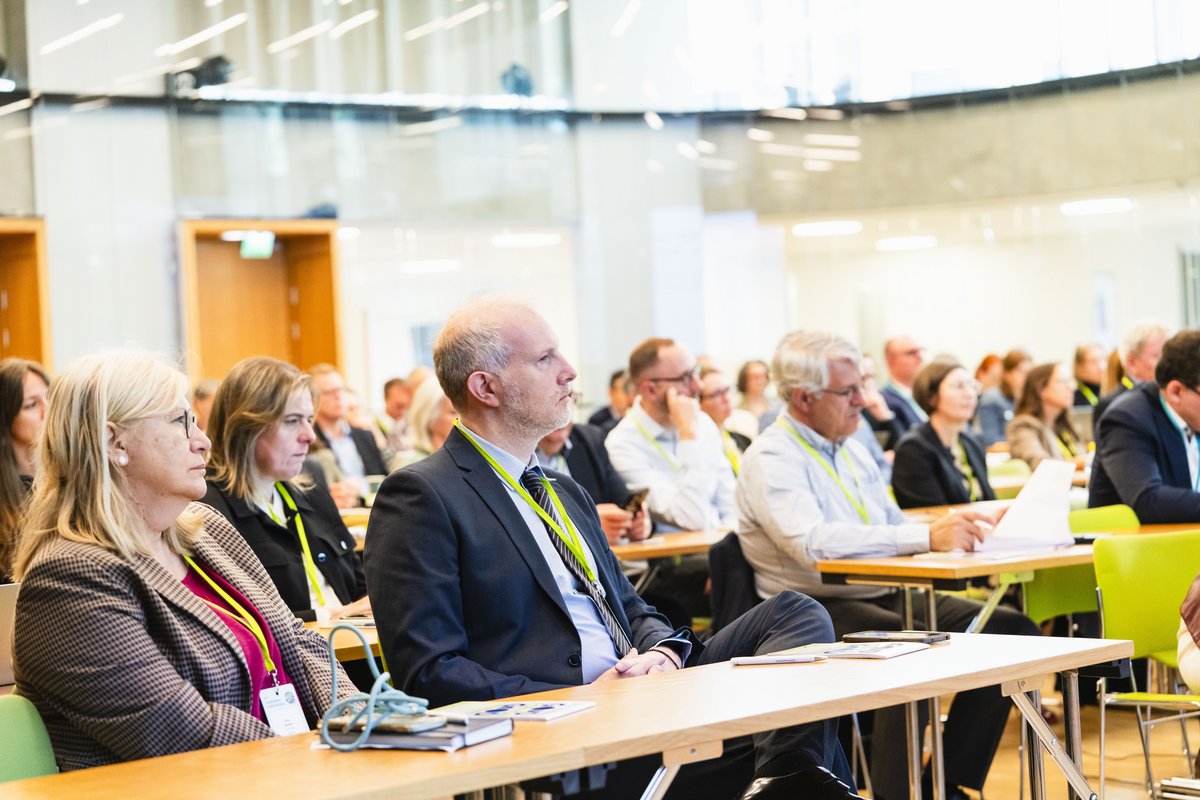
How should standardisation, testing and certification respond to the digital and green transitions so as to contribute to workplaces being safe and healthy? At the end of May, over 100 experts from across Europe met in Helsinki to discuss these questions at the 9th EUROSHNET Conference on Standardization, Testing and Certification in Occupational Safety and Health.
The conference focused on the two major transformational processes of our time: climate change and digitalisation. Both are having significant impacts on the world of work and present new challenges for regulation and standardisation. Raimo Antila, from the Finnish Ministry of Social Affairs and Health, emphasised that a single stakeholder alone is unable to cope with climate change and the digital transformation; close cooperation is called for between legislators, enterprises, the social partners, OSH institutions and standards bodies.
Occupational safety and health is a factor in competition. This point was made clear by Nikolaos Mitsouridis (Directorate-General for Employment of the European Commission) at the outset of the conference. He noted that occupational safety and health legislation in the EU is well established, but must be updated selectively where necessary.
The EU Standardisation Regulation is a key element of standardisation policy. The regulation’s latest revision has the purpose of strengthening participation by relevant stakeholders in standardisation activity and of making standardisation processes more efficient, for example through new digital tools such as the Online Standards Development Platform (OSD) and the provision of standards in machine-readable form. However, Ewa Zielińska (Polish Standards Institute, PKN) made it clear during the discussion that speed must not be allowed to become an end in itself. Standardisation procedures need to be timely rather than fast. Otto Görnemann (SICK AG) reiterated that standards with a bearing on safety, in particular, require sufficient time for technical consultation, and that even digital tools are not able to change this fact.
Climate change
Climate change brings with it a multitude of new or heightened risks, such as an increase in heat stress and UV exposure, extreme weather events and the spread of infectious and allergic diseases. The low-carbon economy, the circular economy and alternative sources of energy are giving rise to new occupational safety and health requirements. The capacity of materials and electronic systems to function can also be impaired by environmental factors such as high temperatures.
Thomas Alexander (German Federal Institute for Occupational Safety and Health) made it clear that numerous structures and tools are already available for tackling these challenges. He argued that above all, an integral approach – one covering all sectors and countries – must be pursued, rather than isolated solutions. Proven solutions to many problems already exist in other parts of the world, and could be adopted in Europe. This requires intensive international dialogue between the scientific community, the social partners and stakeholders in occupational safety and health.
Personal protective equipment
New technologies also necessitate further development of the EU Regulation on Personal Protective Equipment (PPE). Pilar Cáceres (INSST) set out how aspects such as the online retail trade, smart PPE, and the differing needs of older people, people with disabilities, neurodiverse individuals, and children, and psychological factors such as cognitive overload or changes in risk behaviour caused by new technologies, have been given little or no consideration to date.
The presentation by Natalie Wilson (Workwear Solutions International) highlighted the urgent need for greater inclusivity in standards and standardisation committees. She criticised the dependence of many standards and products upon outdated anthropometric data and their failure to take the needs of women and other user groups adequately into account. A particularly striking example is that the smallest glove size tested against the standard is too large for 86 per cent of women. Poorly fitting PPE often leads to workers altering their own PPE themselves, which poses additional risks to safety and health. A study by the European Commission identified 76 PPE standards which, owing to their inadequate inclusivity, pose a safety risk and are in urgent need of revision.
Digitalisation and artificial intelligence
Health and safety regulations are not drawn up with consideration for artificial intelligence; conversely, AI systems do not necessarily take account of safety and health requirements. Nastazja Potocka-Sionek (University of Luxembourg) emphasised that gaps in regulatory provisions currently exist, particularly in the field of algorithmic management, and that further research is needed into the links between AI and risks to safety and health.
The participants of a panel discussion called for a balanced regulation addressing artificial intelligence. Above all, legal certainty is required, by manufacturers and users alike. At present, the requirements are in some cases inconsistent, and are interpreted in very different ways. The European AI Regulation must therefore be urgently translated into sector-specific provisions.
Digitalisation is closely linked to the issue of cyber security. Losses resulting from cyber attacks on businesses amounted to over €200 billion in 2023 in Germany alone. Jonas Stein (DGUV) and Jean-Christophe Blaise (INRS) outlined the relationship between the EU Machinery Regulation and the EU Cyber Resilience Regulation and called for greater attention to be paid to this issue, which is often neglected.
The future of standardization
Finally, the conference turned its attention to the future of standardisation. Kathrin Behnke (European Trade Union Confederation) emphasised that Europe has a particularly high standard of protection in the field of occupational safety and health and should also assert its values in international standardisation activity. At the same time, she pointed out that standardisation is not an appropriate tool for every social problem. Nor can or should it replace legislation. The participants were in agreement on one particular point: standards are an indispensable tool for promoting safety, interoperability and international trade.
Sonja Miesner
miesner@kan.de
Further information
Information on EUROSHNET, images and presentations from the 9th EUROSHNET Conference can be found at: www.euroshnet.eu
About EUROSHNET
EUROSHNET (the European Occupational Safety and Health Network) has been an important European platform for over 20 years, facilitating exchange between experts in occupational safety and health institutions, standards organisations, testing and certification bodies, the social partners, businesses and government bodies. EUROSHNET organises a European conference approximately every two years; the next conference is scheduled to be held in 2028 in Seville.