

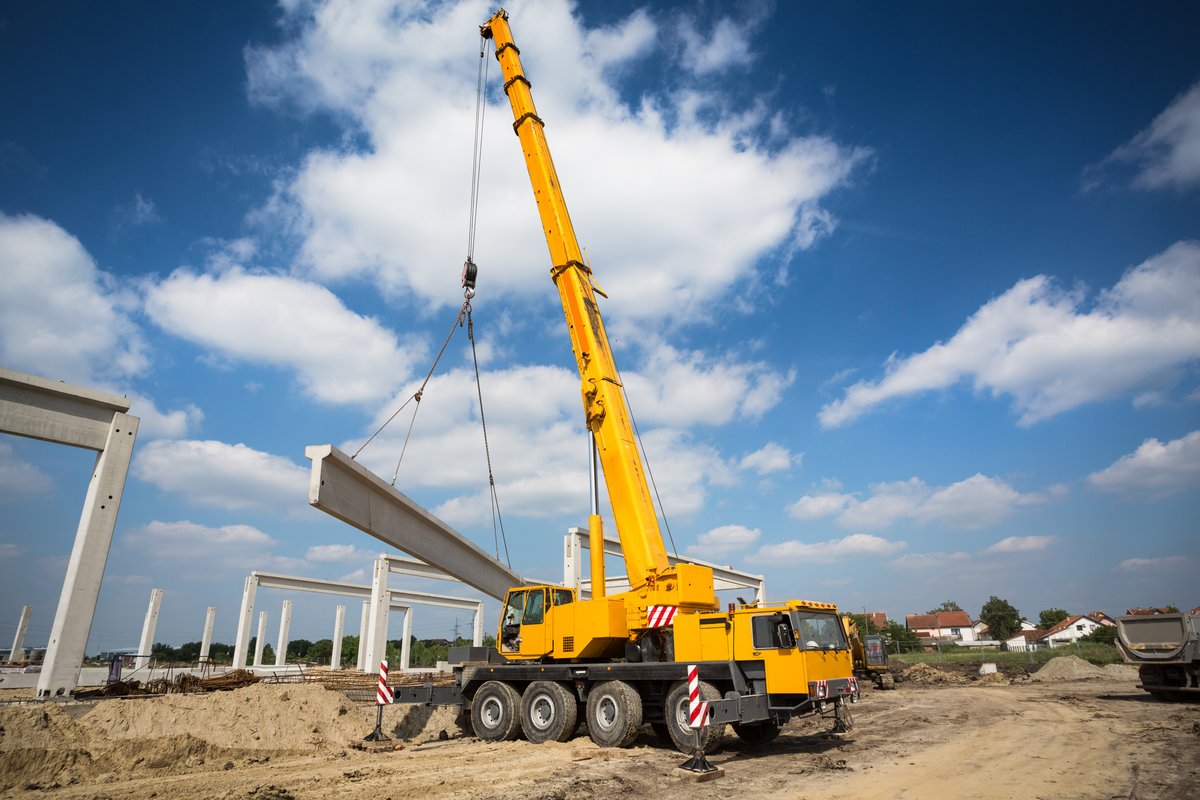
The ropes of cranes and other equipment used for lifting loads must be safe in order to prevent loads from falling. However, incidents have repeatedly occurred in which ropes have failed in service despite having been deemed safe during the regular periodic inspection for the period of use concerned. The Subcommittee Cranes and lifting technology of the Expert committee Woodworking and metalworking of the German Social Accident Insurance (DGUV) calls for the European standard for calculations for crane ropes to be withdrawn.
The service life of ropes is not indefinite and they must be replaced regularly. The deciding criterion for their replacement is attainment of the end of the service life, which marks the point beyond which the rope can no longer be used safely. For cranes, Section 14 (2) of the German Ordinance on industrial safety and health (BetrSichV) and Section 26 of the accident prevention regulation for cranes (DGUV Regulation 52/53) require a periodic inspection to be performed by a competent person. During this inspection, the rope is checked for visible damage that would require its replacement. The view of OSH experts is that the result of the regular periodic inspection must verify that the rope is sufficiently safe for hazards to persons to be ruled out for the duration of the pending period of operation.
The criteria for mandatory discarding of a rope are described in ISO 4309, Cranes – Wire ropes – Care and maintenance, inspection and discard. This standard states forms of damage that necessitate the rope’s immediate replacement. Reasons for immediate discarding of the rope include a certain number of visible wire breaks in the outer strands (bundles of wires). These wire breaks are caused by material fatigue when the rope is guided over sheaves, causing it to be repeatedly bent.
Premature rope failures have particularly occurred in practice when a small ratio of the sheave diameter (D) to the rope diameter (d) is combined with high-strength ropes (wire tensile strength ≥ 2160 MPa and number of strands ≥ 8). The periodic inspections had failed to indicate that these ropes would reach the end of their service life during the pending operating period and that their load-bearing capacity was no longer sufficient.
Research project provides clarity
The German Social Accident Insurance Institution for the woodworking and metalworking industries (BGHM) was tasked by the DGUV with conducting a research project to determine the reasons for the ropes’ premature failure. This project had the following objectives:
- To study the correlation between small bending diameters and the incidence of wire breaks in the inner strands of high-strength ropes
- To determine limits for the D/d ratio at which it is guaranteed that wire breaks occur in the outer strands, thereby permitting their timely detection.
The tests showed that, with use of relatively small sheaves (low D/d ratios), the ropes attained fewer bending cycles on the testing machine before failure than is predicted by the calculations to EN 13001 Part 3-2, Limit states and proof of competence of wire ropes in reeving systems.
Further calculations of the attainable number of bending cycles were subsequently performed in accordance with ISO 16625, Cranes and hoists – Selection of wire ropes, drums and sheaves. These calculations all erred on the safe side: the number of bending cycles predicted by the calculation at the attainment of which the rope would reach the end of its service life was therefore lower in this case than the actual number of bending cycles attained on the test machine.
For this reason, the DGUV’s Subcommittee Cranes and lifting technology recommends that EN 13001-3-2 be withdrawn. The method described in this standard for proof of the fatigue strength does not yield reliable calculation results for small D/d ratios in combination with high-strength ropes. It is recommended that the service life for ropes be calculated in accordance with ISO 16625.
Uwe Streb
Head of the Subcommittee Cranes and lifting technology in the DGUV’s Expert committee Woodworking and metalworking
Uwe.Streb@bghm.de