

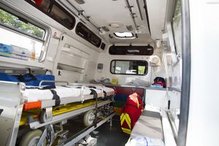
Owing to the particular conditions of use in the vehicle, ambulance service employees are exposed to a significantly increased risk of accident – and must nevertheless be able to work safely during deployments. A range of legal sources support or require the safe design and equipping of the patient's compartment in ambulances:
- Recital 3 of 2007/46/EC expressly aims at a high level of health protection and road safety in harmonized regulatory acts governing vehicles.
- Legislation of the German regional authorities governing the ambulance services requires the vehicles to satisfy the state of the art (and in some cases even higher standards), particularly for safety aspects.
- Section 3 of the German Product Safety Act (ProdSG) states that when used as intended or in a foreseeable manner, products must not endanger the safety and health of persons.
Based on the results of several workshops conducted with operators of ambulance services, KAN became involved in European standardization in this area in 2019. EN 1789 serves as the basis for the design, testing and equipping of ambulances in Europe. By way of a reference in Annex II of the Regulation (EU) 2018/858 on the approval of motor vehicles, EN 1789 has acquired binding force in Europe for the road licensing of ambulances (patient's compartment).
On the initiative of the European Commission, the requirements for ambulances will in future be divided between two parts of the standard. EN 1789-1 will be limited to medical devices and is to be harmonised under Regulation (EU) 2017/745 on medical devices. EN 1789-2 sets out all technical requirements relating to the patient compartment. From an occupational health and safety perspective, this particularly concerns aspects such as the following:
- Avoidance of risks of tripping inside and outside the vehicle
- Avoidance of the ambulance personnel standing unrestrained during travel (ergonomic placement of the work equipment and materials)
- Improvement of the control and maintenance specifications for restraining systems and fixing arrangements (stretcher platform, incubator, etc.) in order to ensure that the safety standards applied during the approval testing are maintained over a longer period of time
- Adaptation of the patient's compartment to legally binding hygiene requirements (design of the floor etc.)
Harmonisation of design requirements for vehicle equipment in European standards is complex, since the ambulance services in Europe differ in their structure and operate under different conditions. Moreover, the traditional framework of occupational health and safety legislation is limited in its applicability to transport vehicles used on public roads. In contrast to traditional product standardization, no requirements to be met by the patient compartment can be derived from European product safety legislation under the New Approach.
The risk assessment required in Germany by the Ordinance on industrial safety and health (BetrSichV) when work equipment is used serves as an important basis for occupational safety in this context. A danger exists however that in practice, some ambulance service operators will overlook important aspects of the very complex risk assessment and will thus be unable to implement occupational safety and health in full.
For this reason, KAN has therefore called upon BG Verkehr, the German Social Accident Insurance Institution responsible for the transport industry, to formulate a DGUV Rule to support ambulance services in the procurement of safe vehicles. This document is currently being drawn up in collaboration with BG Verkehr, operators and test bodies. The combination of standards and the rules and regulations of the German Social Accident Insurance Institutions will thus provide operators and emergency service employees with a comprehensive framework for working safely.
Michael Robert
robert@kan.de