

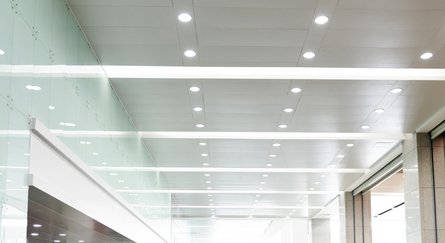
The lighting at work premises often impacts upon the safety and health of workers at work. In principle, the European legal framework makes no provision for standards in this area. Nevertheless, standards governing lighting at work premises have been and continue to be developed. KAN's view is that the German national foreword of such standards must state that national provisions governing lighting at work premises exist that extend beyond the scope of the standard. References at this point to the German Ordinance on Workplaces and to relevant state rules and regulations and those of the German Social Accident Insurance Institutions assist the user of the standard in observing the binding regulations.
Dr. Anna Dammann
dammann@kan.de
EN 12464-1, Light and lighting – Lighting of work places – Part 1: Indoor work places includes comprehensive requirements concerning the safety and health of workers at work, such as minimum values for the lighting of different workplaces. At the same time, requirements for lighting at workplaces in Germany are set out in state regulations and those of the German Social Accident Insurance Institutions, in particular in the ASR A3.4 workplace regulation governing lighting. The areas of overlap, deviations and links with and between the standard on the one hand and the body of German regulations and those of the accident insurance institutions on the other present challenges in practice, for example for persons responsible for the planning of lighting.
KAN’s objective is to promote a practical, cohesive body of OSH regulations. Therefore, clarification was first necessary of where OSH documents and the standard coincide in their requirements, and where they differ. The resulting implications for practical application were also to be considered. For this purpose, KAN invited tenders in 2022 for production of an expert report. In two meetings, experts from among KAN’s stakeholders discussed the results and formulated recommendations based upon it. The report “Comparison of the requirements for workplace lighting in the body of official German rules and regulations and those of the German Social Accident Insurance Institutions with those in standards” was published in 2023.
Non-visual effects of light
Besides enabling human beings to see, light also has non-visual effects upon the human body. Non-visual effects of light influence human physiology, mood and behaviour. Light can for example briefly raise attentiveness, and may also influence the human biological clock and thus also the circadian (i.e. daily) rhythm.
Besides being exerted by daylight, these non-visual effects can also be produced by special artificial lighting. Daylight, however, dictates the natural rhythm for each individual's inner clock. Artificial lighting may have similarities to daylight but is not a substitute for it in every respect.
In 2015, KAN published a position paper on the subject of non-visual effects in standardization. Since further observations have been made and agreements reached in discussions between the stakeholders since the position paper was published, it was last updated in 2022.
The following documents addressing the non-visual effects of light have been published for the planning of lighting installations:
- DGUV Information 215-220 "Nichtvisuelle Wirkungen von Licht auf den Menschen" (Non-visual effect of light upon human beingsonly, only available in German)
- Empfehlung des Ausschusses für Arbeitsstätten (ASTA) – Künstliche biologisch wirksame Beleuchtung in Arbeitsstätten“ (Recommendations by the ASTA state committee for working premises (2018) stating that use of artificial lighting with a colour of < 4100 K during the night and continuous cold light with high illuminance levels should be avoided, only available in German)
Related KANBrief articles
More information
- A+A 2021 Düsseldorf Expert interviews on the non-visual effects of light (in German)
- KAN-literature review "Gesicherte arbeitsschutzrelevante Erkenntnisse über die nichtvisuelle Wirkung von Licht auf den Menschen" (Validated OSH-related findings concerning the non-visual effect of light upon human beings, abstract in English), August 2018