

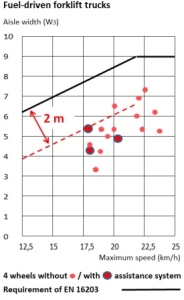
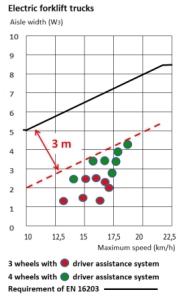
Results
The test results (see diagrams) show the stability limit of each fork-lift truck at a given top speed (correctly negotiated minimum aisle width W3): the lower the value of W3, the higher the stability of the fork-lift truck. The stability limits specified in the standard are shown by an unbroken black line. The stability of the fork-lift trucks was found to be considerably greater than that required by the standard. The most stable were three-wheel electric fork-lift trucks with a maximum speed below 17 km/h and on which the speed-limiting effect increased as the bend became tighter. The particular safety benefit offered by driver assistance systems is that they can substantially reduce the risk of tipping as a result of excessively high cornering speed.
A further stability criterion that was recorded was how often in the four last and therefore most demanding test runs the inside rear wheel lifted off the ground during cornering. Five of the eleven fork-lift trucks tested completed these four final runs without lifting of the rear wheel off the ground being observed. The most stable four-wheel fork-lift trucks are those with a combination of speed reduction in bends and locking of the rear axle (Conception innovante de béquilles latérales pour chariots élévateurs […]. INRS, Note Scientifique et Technique N°342. Mai 2016).
The results are being used firstly in order to encourage revision of the stability limits in the standard, and secondly to encourage users to select safer products.
Jérôme Rebelle Marcus Gaub
jerome.rebelle@inrs.fr m.gaub@bghw.de